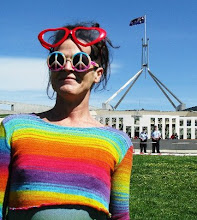
I who may well be...

Musings from the perspective of a human being who may well be not locatable completely within the usual categories of male or female or gay or straight or transsexual or intersexed or exploiter or exploited or supplier or consumer or performer or spectator.

Tuesday, October 27, 2009

Sniffer Snuffed

Friday, August 28, 2009

Rozelle Metro going nowhere

Wednesday, July 01, 2009

Star Drek

Called Star Trek, but mostly different actors and mostly different characters and totally different continuity (and totally different laws of physics) but with familiar names and accents and catch lines, a technically competent but soulless impersonation.

There's a difference between science fiction and pop fiction, and it's the difference between Gene Rodenberry's artistic vision and this corporate brand bland product : /

For the love of science, for example, at what point in time does Scottie invent a technique he first hears of from his future self via future Spock?

For the love of logic, how can Spock assert to his younger self that his is not their father? This is an illogical assertion, given that elder Spock now knows he can travel through time and easily interact with key figures in his history, including himself.

And for the love of us, why tell us we could live in a Universe so scary that at any moment our entire galaxy may be consumed by supernovae? Fear mongers! Yes, supernovae happen, and at worst never affect further than 50 light years, which is a long way, but it's a VERY big galaxy.

Nor we need fear an assault of crazed megalomaniacs from the future with advanced technology. The universe is far more lovingly constructed than that. OK, that's an emotional opinion, but you know what I mean, and it's up to you to make your own truth by telling yourself your own story : )

I love the inclusive pluralist and intellectual values of Roddenberry's Star Trek, and reject the fear mongering and insults to intelligence marketed by the megacorporation milking its inherited property.

Love well and prosper ; )

Friday, June 26, 2009

Parliament frozen in time

Tuesday, May 26, 2009

four pigmen of the apoclaypse

working the front page

Saturday, March 28, 2009

dog bites ass

Friday, March 20, 2009

Vale Paris

Paris, an Aboriginal transgender friend of mine, was found hanging dead in her prison cell on Monday.
I'm glad she lived as long as she did, given the forces arrayed against her. And I am glad it looks more likely she was not kiiled simply by the prison system, as so many tranys were, but by the sort of thing almost inevitable given the number of people with serious grudges against the poor girl. But I am having a little bit of a crying day for her. She never done me wrong, and I knew her about twenty years from when she was but a teenage queen at the Courthouse hotel early opener, before she became a scene stealer on William Street, a black Barbie doll with attitude. She even featured in my comic book An Hour on the Life of a Spansexual Sex Worker, which records my view of the incident when she was first banned from one of the safe houses (which is now closed). Vale, Paris.

Rebel Rabbi

"Rebel priest" Father Peter Kennedy, who ignores the Pope's insistence on misogyny and homophobia, was likened by Tony Abbott on Q and A to a backbencher challenging the PM. However, there is a more apt and religious analogy, for he is more like the Rabbi Jeshua (Jesus) opposing the snobbery and authoritarianism of the Pharisees. The Roman Empire got him too, but his message of love and inclusion of all lives on, and empires come and go.

Labels: , , , , ,

Wednesday, March 18, 2009

Tick a box: male, female, unspecified

There's a quote from me in this article on the op ed page of today's SMH

http://www.smh.com.au/opinion/tick-a-box-male-female-unspecified-20090317-90x4.html?page=-1#

Tick a box: male, female, unspecified

* Katrina Fox
* March 18, 2009

Are you male or female? For most of us, answering that question is no problem, although whether we want to is another matter. But for some people, these categories simply don't fit. They consider themselves neither male nor female - essentially, genderless.

Take Norrie May-Welby, an activist and performer in Sydney, who says: "Some of us have found it better to identify in non-gender-specific ways; it's not our life and those roles don't fit us."

May-Welby uses pronouns such as "zie" in place of "he" or "she", and "hir" in place of "him" and "her", and says: "Some people get angry with the idea that I'm not a man or woman. It's fair to say there's sexual anxiety underneath it: they're thinking, 'If I'm attracted to this person who is neither male nor female, they've shattered my idea of myself as straight or gay.' "

Rejecting such deeply entrenched cultural norms has its challenges. Aside from being branded a freak and suffering the occasional physical attack, genderless people claim they are forced to lie every time they fill out a form. Whether it's a job application or government document, they, like the rest of us, are required to tick the "M" or "F" box, with no other options.

But this will change if the Australian Human Rights Commission has its way. In its report Sex Files: The Legal Recognition Of Sex In Documents And Government Records, launched yesterday, the commission recommends that anyone over the age of 18 should be able to choose to have an "unspecified" sex noted on documents and records, and where possible sex or gender questions should be removed from government forms and documents.

For May-Welby, such a move will be "freeing" and enable May-Welby to "just be another human like everyone else". But what does it mean for the rest of society? Is it, as the Australian Family Association spokesman, John Morrissey, puts it, "a crazy ideological agenda behind getting rid of gender", or the start of an egalitarian utopia in which no one is discriminated against because of their biological sex or gender presentation?

There are times when not being asked to specify your sex or gender can work to your advantage - in job applications, for example. We'll never know how many times we've missed out on an interview because our application was rejected at the sifting stage because of gender or sex bias. And what the person selling us a packet of cashews or removing our appendix has between their legs is hardly relevant to the task at hand.

There is a difference between sex and gender: sex refers to our physical make-up and biological structures, while gender is about how we perform, whether we do "masculinity" or "femininity". But the terms are often used interchangeably on legal and government documents.

If the thought of a gender other than male or female sends you into meltdown, bear in mind that it is the natural order of any society to progress. Australia looks very different today from 100, 50 and 20 years ago. Gay and lesbian couples are set to benefit from new equality law reforms starting in July, so it's not such a great leap to embrace the concept of sex and gender diversity.

We've already come a long way in this area. The 1990s saw the birth of the "trans" liberation movement. Identities including transsexual, transgender and transsexed became part of the lexicon. Since then, television networks have fallen over themselves to include trans characters in their shows (Ugly Betty, Dirty Sexy Money) and Hollywood has considered them worthy subjects of films (Transamerica, Boys Don't Cry).

Now it's time to get our heads around even more fluid sex or gender identities and the possibility of relating to some people as genderless - even if that challenges our assumptions of our sexuality.

We may be far from a perfect world in which no one is judged negatively solely on the basis of their biological sex, gender performance or sexuality, but the commission's recommendation for an extra category of "unspecified" sex and gender markers on legal and government documents is a good start.

It is not the end of gender, and it doesn't mean the end of male and female identities. It is simply an acknowledgment of a diversity that needs to be recognised. If the Federal Government adopts the recommendations, it will put Australia at the forefront of pioneering human rights legislation, and that's surely something to be celebrated.

Katrina Fox is a freelance writer and the co-editor of Trans People in Love.